

Why the economics of building just changed forever and what it means for every industry
For four decades, the software industry ran on a single dominant philosophy. Convince enough organisations that their unique problem is actually the same as everyone else's, then compete on who has the best solution to this now identical problem.
It worked because building software was genuinely expensive. The only way to justify the investment was scale and the only way to get scale was to make every problem look the same. So the customer changed to fit the tool, not the other way around.
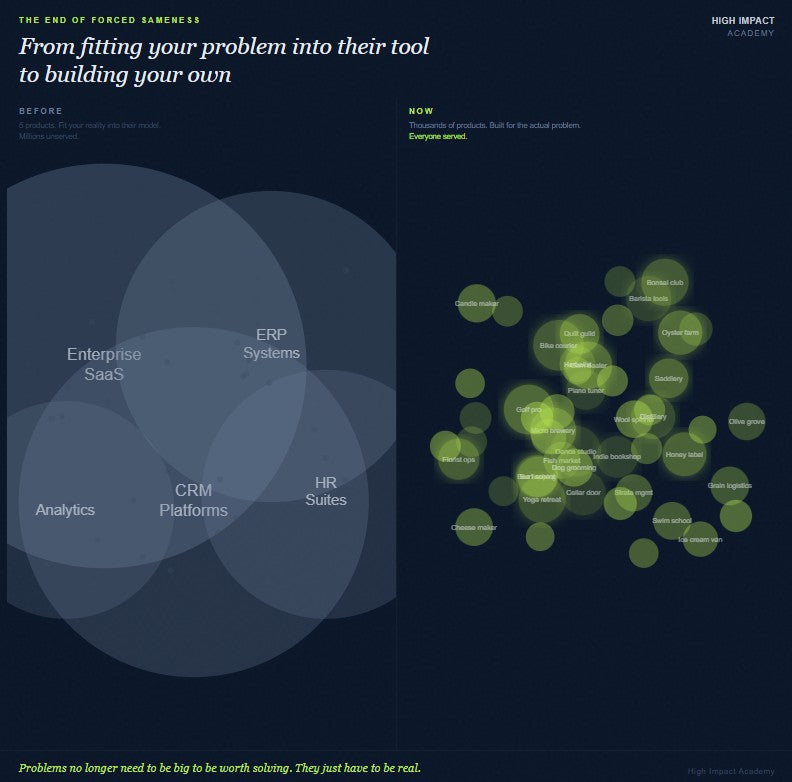
Think about what that actually meant. CRM told every sales team, regardless of market, cycle or relationship, that selling looks like this: a pipeline, stages, a forecast. Fit your reality into our model. HR systems treated every organisation's people processes as identical. ERP forced every operation into the same structure. Project management tools imposed one workflow on a thousand different kinds of work.
The pitch was always "best practice," but the reality was "only economically viable practice."
The cost of sameness
This dominant philosophy produced enormous value but it also produced enormous gaps. It meant the truly specific problems, the ones that didn't fit any template, just went unsolved. Not because they weren't real and not because people weren't losing time and money dealing with them manually every single week but because nobody could build a business case for a market of 300 people.
The grain logistics operation in regional Queensland that runs on spreadsheets and phone calls because no software company ever thought 200 potential customers justified the build. The swim school juggling enrolments across three incompatible systems because nobody made one that understood how swim schools actually work. The strata manager still using a process designed for a world that doesn't exist anymore because the market was too small for anyone to care.
These aren't edge cases. They are the majority of problems in the real economy. Most businesses don't operate at the scale that justified four decades of enterprise software investment. They adapted to tools that were never built for them and accepted the friction as normal.
The constraint disappears
That constraint is now gone. Overnight.
When one person with deep domain knowledge can build a working product in days for almost nothing, the entire logic inverts. You don't need to make the problem generic to justify solving it, you can solve it in all its weird, specific local detail and that specificity becomes the value, not the obstacle.
AI has collapsed the cost of building software so dramatically that the economics no longer demand scale. A single person who deeply understands a problem can now design, build, test and ship a solution without a pitch deck, a seed round or an 18-month roadmap. Just deep domain knowledge meeting near-zero friction to build.
The product doesn't need 10,000 customers. It needs 200 who'll pay properly because it solves their actual problem, not a generalised approximation of it.
The long tail of problem-solving
We are moving from a world where problems had to be big enough to be worth solving to one where they just have to be real enough.
The analogy that keeps coming back is publishing. Before the printing press, books were handmade for elites. The press democratised access but it imposed its own economics. You still needed a publisher, a print run, distribution. The internet removed those constraints and suddenly there were blogs, newsletters and niche publications serving communities of a few hundred people. The long tail of content exploded.
We are at that same inflection point for solutions. Not just content but functional tools, workflows, products and services. The long tail of problem-solving is about to explode in exactly the same way.
What was previously a market dominated by a handful of large generic platforms becomes an ecosystem of thousands of precise, niche tools each built by someone who actually understands the problem from the inside.
The company changes too
If problems no longer need to be big to be worth solving, the company solving them doesn't need to be big either.
Building software used to require engineers, designers, PMs, QA, DevOps, support and sales. Not because all those roles added value to the end user, but because the complexity of building and shipping software demanded them. Remove that complexity and most of those layers become overhead, not capability.
One person can now build the product with AI-assisted development. Iterate on the interface in hours, not sprints. Generate the documentation. Handle most support. Produce the marketing. Run billing and infrastructure on platforms that abstract everything away. Each of those used to be a hire, now it's a workflow.
So instead of one person, one product, grinding at capacity, you get one person, five products, each serving a tight niche, each generating real revenue.
A portfolio of small bets
The risk profile inverts. Instead of one big bet with everything riding on it, you've got five or six smaller ones. If one stops working you wind it down and build the next one in a fortnight. The cost of failure drops so low that experimentation becomes the default, not something you have to budget and committee your way into.
The operator spends their time on the only things that actually require them: choosing which problems to solve, maintaining relationships with their users and making the judgement calls about direction. Everything else is handled by AI and infrastructure that didn't exist two years ago.
This isn't the startup mythology we grew up with. There's no singular big bet, no decade-long grind toward an exit, no scaling to 200 people. It's someone who quietly runs six niche products, earns well, serves real communities and never appears on a single podcast. That's not a less ambitious life, it might be a more ambitious one. It's just ambitious in a way our culture doesn't have a story for yet.
What this means for leaders
If you lead a team, a function or a business, the implications of this shift are immediate and practical.
The software you've been paying millions for was built on the assumption that your problem is the same as everyone else's. That assumption is breaking. The question is no longer "what software should we buy" but "what should we build ourselves, what do we need a platform for and what just disappears entirely?"
Your competitive moat may also be thinner than you think. If an AI-native competitor can enter your market tomorrow with a fraction of your headcount and none of your overhead, what exactly are they unable to replicate? The answer had better be something human. Judgement, relationships, domain expertise, trust built over years. If your advantage is a process or a system, that advantage has a shelf life that just got dramatically shorter.
The people who thrive in this next phase won't necessarily be the best builders. They'll be the ones who spent years watching a problem, deeply understanding the people affected by it and now realise they can finally do something about it.
They'll be the best noticers.
The question for every leader is whether you're building the capability in your organisation to notice, to judge and to move. Because the constraint that used to protect you from competition is the same one that just disappeared.
High Impact Academy is built for professionals and leaders who need to think clearly, decide confidently and deliver results in an environment that does not slow down. Explore the platform, take your free future readiness assessment and start building the readiness that matters.
Explore High Impact Academy →